The Toolkit
Each rung of Pearl's Ladder demands different tools. No single platform spans all three — but the right combination does.
1AssociationRigorous Rung 1 analysis — correlations, regressions, latent structure. The empirical foundation for everything above.
Before you can reason causally, you need to understand what your data actually contains. Correlation matrices feed into SEMs, regression coefficients become path estimates, Bayesian posteriors become priors for causal inference. Shoddy Rung 1 work means shoddy causal conclusions.

2StructureDiscovering the graph — which variables cause which. The bridge from correlation to causation.
Pearl proved that no amount of observational data can answer causal questions without causal assumptions. These tools learn and encode that structure — discovering the directed graph from data, integrating expert knowledge via whitelists and blacklists, and testing d-separation implications.


3CausationIntervention, counterfactual reasoning, and optimal decision-making under uncertainty.
These tools answer the questions from The Problem: "What happens if we intervene?" and "What would have happened if we had acted differently?" Full Rung 2–3 support means do-calculus, structural causal models, and utility-optimised decisions.


JASP (Jeffreys's Amazing Statistics Program) provides the ideal environment for Rung 1 associational analysis: the correlations, regressions, and factor structures that form the empirical foundation for causal models.
Almost every frequentist analysis has a Bayesian counterpart — Bayes Factors for group differences, posterior distributions for regression coefficients, evidence for the null hypothesis. This dual paradigm lets you build your foundation using whichever inferential framework fits.
Key Capabilities
Why It Matters for Causal Work
Causal models must be consistent with observed associations. Correlation matrices feed into SEMs, regression coefficients become path estimates, and Bayesian posteriors become priors for causal inference. Shoddy Rung 1 work means shoddy causal conclusions.
Download JASP →
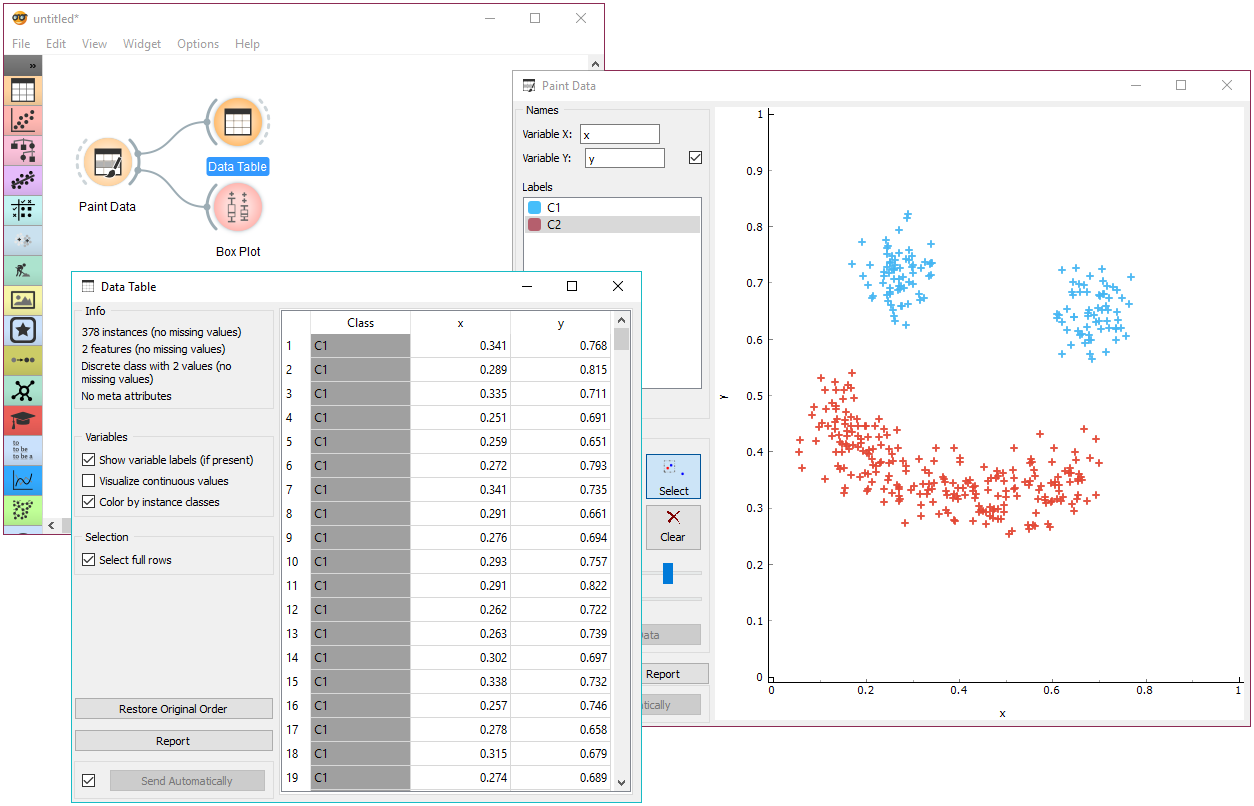
Orange is a visual programming environment for data science. Build analytical workflows by dragging widgets onto a canvas and connecting them — the same algorithms as scikit-learn, but accessible to domain experts who don't write Python.
Selections in one visualisation highlight in every other — linked brushing reveals patterns that static analysis misses. Workflows are self-documenting: the visual pipeline is the analysis record.
Key Capabilities
When to Use Orange vs. KNIME
Start with Orange for learning, exploration, and rapid prototyping. Move to KNIME if you need enterprise deployment, governance, or team collaboration at scale.
Download Orange →
bnlearn implements the most comprehensive set of structure learning algorithms available in any language — constraint-based (PC, GS, IAMB), score-based (Hill-Climbing, Tabu), hybrid (MMHC), and specialised classifiers (TAN, Naive Bayes). Two companion textbooks and thousands of citations make it the R standard.
Supports discrete, Gaussian, and conditional linear Gaussian networks. Bootstrap arc strength assessment, model averaging, and causal inference via do-calculus.
Key Capabilities

Netica lets you draw network structures graphically, enter probabilities via tables or equations, learn from data, and perform inference immediately. Belief bars update in real-time as evidence is entered. Influence diagrams enable optimal decision computation.
Full causal ladder support: Pearl's do-calculus for interventions (Rung 2), structural modelling for counterfactuals (Rung 3), and standard inference for association (Rung 1). Thousands of academic citations across environmental modelling, medical diagnosis, and risk assessment.
Key Capabilities

Bayes Server is a commercial platform for building, learning, and deploying Bayesian networks with full support across all three rungs of Pearl's Ladder — association, intervention, and counterfactual reasoning. Unlike black-box ML, Bayesian networks make their assumptions explicit through graphical structure.
Gaussian Linear Networks scale to thousands of continuous variables with exact inference — critical for enterprise sensor networks, financial systems, and industrial IoT. Decision graphs with utility optimisation enable optimal action selection under uncertainty.
Key Capabilities

DPL uniquely combines Influence Diagrams (for framing) with Decision Trees (for structure). The Influence Diagram is the "whiteboard"; the Decision Tree articulates how decisions and uncertainties unfold chronologically. Changes in one view automatically update the other.
Policy Trees identify optimal strategies. Tornado and rainbow diagrams reveal which variables matter most. Value of Information calculations tell you whether to invest in more research before deciding. Deep Excel integration lets you leverage existing financial models.
Key Capabilities
Industries
Pharmaceutical, Oil & Gas, Utilities, Mining, Aerospace & Defense, Consumer Products.
Visit Syncopation →